

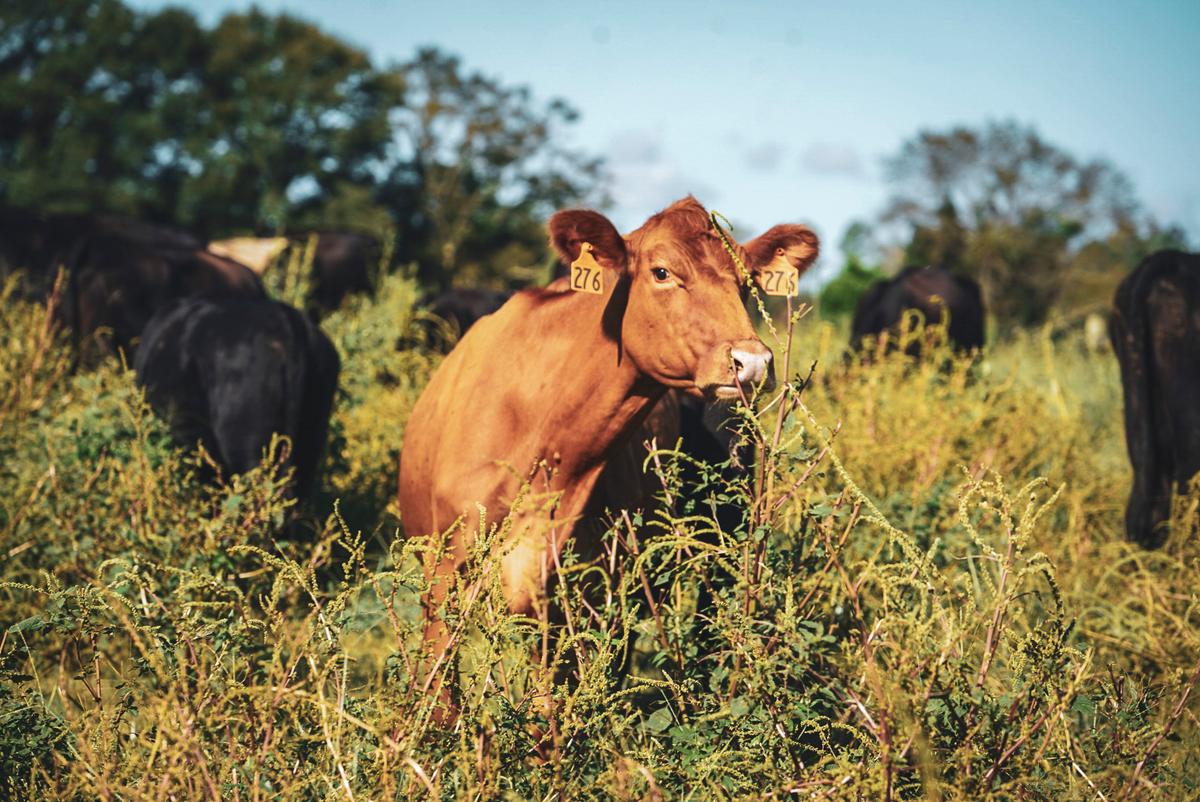
(The Epoch Times)—For three generations, the Harris family farmed south Georgia-based White Oak Pastures the conventional way, relying heavily on chemicals, pesticides and antibiotics. In the mid-1990s, fourth generation farmer Will Harris started the transition to regenerative methods, which prioritize building and preserving healthy soils, avoiding synthetic fertilizers and pesticides, and minimal or no tilling.
Like many regenerative farmers and proponents, Harris intently listened to Agriculture Secretary Brooke Rollins’ Dec. 10 introduction of a Regenerative Pilot Program that will allocate $700 million to support regenerative agriculture.
“For the first time in my lifetime, the USDA is publicly showing an interest in this kind of production, and that is encouraging,” Harris said.
Harris told The Epoch Times that White Oak started transitioning to regenerative farming in 1995.
In 1976, he graduated from the University of Georgia with an animal science degree, returned to the farm, and ran it as an “industrial, conventional, monocultural cattle guy just as my father was.”
“We were heavily invested in all the tools, pesticides, chemical fertilizer, and antibiotics. We didn’t make a lot of money, but we were profitable,” said Harris, who is also the founder of the Center for Agricultural Resilience, an organization centered on education about the benefits of regenerative farming.
“All of those ways have negative unintended consequences—like degradation of the soil and water, and poor animal welfare. It’s hard on the land, the water, the environment, and all of the animal species,” he said.
Regenerative farming, Harris said, “respects the cycles of nature.”

Rollins made the announcement at a press conference Dec. 10, alongside Secretary of Heath and Human Services Robert F. Kennedy Jr., Centers for Medicare and Medicaid Services Administrator Dr. Mehmet Oz, and regenerative farmers from California, Indiana, and Missouri.
“Protecting and improving the health of our soil is critical, not only for the future viability of farmland, but to the future success of American farmers,” Rollins said.
“In order to continue to be the most productive and most efficient growers in the world, we must protect our topsoil from unnecessary erosion and boost the microbiome of the soil,” she added.
The program will take funding from existing USDA conservation programs, including $400 million from the USDA’s Environmental Quality Incentives Program and $300 million from its Conservation Stewardship Program, according to a USDA press release.
It will be managed by the Natural Resources Conservation Service (NRCS).
Kennedy said the program will give farmers who are dependent on chemical and fertilizer inputs “an off-ramp” to help them transition to a model that emphasizes soil health.
“With soil health comes nutrient density,” Kennedy added.
The program aligns with the MAHA Commission’s focus on addressing the nation’s chronic disease epidemic by strengthening the nutrient density in food and decreasing reliance on chemicals, Kennedy said.
A regenerative farmer based in Mississippi, Allen Williams is cofounder of the Soil Health Academy and Understanding Ag, which help farmers, ranchers, and growers implement regenerative principles and practices.
Williams holds a doctorate in livestock genetics from Louisiana State University and pioneered many early regenerative grazing protocols and forage finishing techniques. He now teaches those principles to farmers globally.
“We’ve never had this kind of funding allocation earmarked for regenerative farming. This opens the door for future funding, and for shaping future agriculture policies on Capitol Hill because more legislators will be familiar with the benefits of regenerative farming methods,” Williams told The Epoch Times, adding that he is “cautiously optimistic.”
”It’s still government, still bureaucracy, but it’s absolutely a major step forward. It heightens public awareness and interest in what regenerative farming is all about, which is as important as the $700 million itself,” Williams said.

Williams defines regenerative agriculture as “farming and ranching in synchrony with nature to repair, rebuild, revitalize and restore ecosystem function.”
“The key part is the last sentence of that definition—starting with life within the soil, and then expanding the life above. That clearly distinguishes it from conventional farming because the conventional way is all about the chemistry of the soil, not the life in the soil,” Williams added.
American farming was decimated by the Dust Bowl in the 1930s. In response, Congress created the NRCS with the intention of improving the land and conserving America’s soil and water resources. Between 1948 and 2021, total U.S. farm production increased 190 percent, while total farm inputs—including land, labor, and water—decreased about 2 percent in the same period.
In a Dec. 10 press release, NRCS acknowledged that “current conservation programs at USDA have become overly burdensome and farmers are bogged down with red tape whenever they try to adopt soil health and regenerative agriculture practices.”
USDA data shows that farmers recently reported 25 percent of their acreage having water-driven erosion concerns and 16 percent of acreage having wind-driven erosion issues, according to the press release.
The pilot program addresses these challenges by reducing administrative burdens for producers, expanding access to new and beginning farmers, and boosting yields and long-term soil resilience across operations, the NRCS said.

Describing the program on its website, the NRCS added that “for too long” funding has “unintentionally encouraged isolated, practice-by-practice conservation, rather than holistic management.”
Through the pilot program, farmers can bundle multiple regenerative practices into one application, “streamlining the process and increasing flexibility for operations,” the NRCS press release said.
The program is designed for farmers who are “ready to take the next step in regenerative agriculture,” the NRCS added.
NRCS will also establish an advisory council composed of farmers, consumers, and private partners.
The council will include 15 members—nine regenerative farmers representing production systems, three corporate supply-chain or consumer packaged goods representatives, and three consumer or MAHA representatives, the NRCS reported.
Rick Clark, an Indiana-based regenerative farmer and co-founder of American Regeneration, an organization committed to advancing regenerative agriculture initiatives, called the pilot program “a victory for regeneration” and said it is “exactly what the farmer needs to start making changes on their farm.”

After the Dec. 10 announcement, Clark participated in a roundtable representing producers who are showing the viability of regenerative agriculture at scale.
“To see regenerative agriculture recognized at the highest levels of government is incredibly encouraging,” Clark said. “Being asked to represent farmers in this conversation shows that the USDA is finally listening to producers who have proven that regenerative systems work at scale.”
Angela Huffman is president of Farm Action, a regenerative farming organization. She said in a statement that “done right, this investment will help farmers lower their input costs, break free from the export-driven commodity overproduction treadmill, and move toward healthier, more resilient, and more profitable farming systems.”
Huffman urged the USDA to take steps to ensure that small, independent farms receive assistance.
“If the Trump administration wants this initiative to succeed, USDA must make sure the Natural Resources Conservation Service—after significant funding cuts—has enough staff to get these dollars out quickly and fairly, reaching farmers across America, not just the largest operations by default,” she said in a statement.
Two regenerative farmers, who spoke to The Epoch Times on the condition of anonymity, said that they are skeptical of the pilot program, citing their belief that NRCS practices are ecologically unfavorable and their doubts about the efficacy of government grants.
Some MAHA advocates have expressed their disapproval of EPA policies. Aubrey Bettencourt, Chief of the NRCS, on Dec. 10 said that her organization is in discussions with EPA Director Lee Zeldin and his staff.
“We’re very, very confident of his [Zeldin’s] commitment to make sure to reduce toxic exposures to the American people,” Bettencourt said.
The Small Business Administration (SBA) also indicated its backing of regenerative farming.
SBA Director of Rural Affairs Richard Kingan described the pilot program as “an initiative that reflects a forward-thinking commitment to healthier communities and a resilient food supply.”
“Family farmers are the original small business owners—and by cutting red tape for them, this administration is making it easier to continue producing nutritious and affordable foods that local communities rely on,” he said.

John Klar is an attorney turned regenerative cattle farmer in Vermont. He works with the nonprofit MAHA Action and is the author of “Small Farm Republic” and an upcoming book, “The War on Farmers: How Corporations, Activists, and Climate Alarmists Are Fueling a Global Food Crisis.”
Klar told The Epoch Times that he is encouraged by Bettencourt’s comments about Zeldin and by Kingan’s remarks.
“The MAHA movement needs multi-agency alliances to overcome the systemic problems plaguing Americans’ food supply,” Klar said. “The pilot program is an important first step in the right direction. Support from the SBA and the EPA is a welcome second.”
As part of the “Make Our Children Healthy Again“ strategy, released in September, HHS is also investing in research on the connection between regenerative agriculture and public health, developing public health messaging explaining this connection.
Williams told The Epoch Times he would like to see the government change its policies, subsidies, incentive programs, and crop insurance programs to encourage regenerative farming over conventional methods.
Regenerative farming methods can be more profitable than conventional methods because they require fewer subsidies, incur less debt, and generate crops that are not as susceptible to damage from fungal diseases and pests, Williams said.
“It’s important we educate our lenders, too, because a regenerative farmer is a significantly lower risk to the lender than a conventional farmer, but the vast majority of lenders do not recognize that yet,” he added.

Regenerative farmers are lower risks for lenders, Williams believes, because they have “more highly aggregated soil, therefore the soil is able to infiltrate water a lot better and retain that water.”
“Flooding and droughts are the two biggest weather-related events that cause crop failure, and that impacts crop insurance payments. Better soil aggregation and water infiltration and retention helps mitigate floods and droughts. Regenerative farming also has fewer issues with pests and focal pathogens,” Williams said. Focal pathogens are micro-organisms that can spread bacteria and toxins.
Harris said conventional farmers are “good people” who “farm the way their father and grandfather did, the way they were taught in college, and the way they are told by pesticide companies.”
Like Williams, Harris would like to see an investment from the USDA into education about the benefits of regenerative farming.
“I think a lot of that change will be made as the older conventional farmers retire and new farmers with a different perspective take over those pieces of land, and recognize that regenerative methods are [respectful of] the environment, and are more profitable and resilient,” he said.
“That’s why it’s so important that more awareness be brought about our way of farming. The pilot program is a positive start.”
Two Storms, One Harvest

Every food crisis in living memory has been a one-shock event. The 2008 price spike was a commodity bubble. The 2020 shortages were a logistics failure. The 2022 grain scare was a war on one exporter’s ports. Each time, the system bent, adjusted, and recovered, and each time the experts assured us afterward that global markets are simply too big and too diversified to fail.
What nobody in Washington seems eager to discuss is that 2026 is shaping up to be something the modern food system has never actually faced. Two independent shocks, one climatic and one geopolitical, are converging on the same harvest cycle at the same time. Not sequentially. Simultaneously.
Start with the weather. The Pacific Ocean is currently building toward what forecasters now openly call a record event. NOAA’s Climate Prediction Center puts the odds of at least a strong El Niño near 88 percent, with roughly two in three odds it reaches “very strong” status, the tier reserved for perhaps three or four events in the entire satellite era. Every major global model now projects a median peak in Super El Niño territory, and most of them project it exceeding the 2015-16 event, which until now held the modern record. Sea surface anomalies were already brushing the super threshold in mid-July, months before these events normally peak. The atmosphere has already shifted into El Niño mode, and the event is forecast to crest in late fall and early winter.
This is not about “climate change.” It’s about the standard cycles of weather, and the cycle we’re currently in is one that has likely devastated societies in the past. We’re better prepared as a society today, but not all Americans are equally prepared.
Serious households have started doing the quiet math on their own. Grocery bills tell part of the story, and the forecast maps tell the rest, which is why long-term food storage has moved from fringe hobby to mainstream line item in the family budget, with established suppliers like Heaven’s Harvest seeing demand from people who five years ago would have rolled their eyes at the idea. That instinct is not paranoia. It is pattern recognition, and the pattern is worth walking through carefully.
Editor’s Note: Heaven’s Harvest IS a sponsor, but the warnings of this article are real and would be written even if we didn’t have a survival food sponsor. With that said, those who take advantage of what they offer can use promo code “Patriot” for 15% off.
The Fertilizer Clock Is Already Running
While the Pacific warms, the second shock has been unfolding in the Strait of Hormuz. The conflict with Iran turned the world’s most important energy chokepoint into a contested waterway, and the consequences reach far beyond the gas pump. Roughly a third of global fertilizer trade moves through Hormuz, and the disruption sent urea prices up 86 percent year over year by March, with a 53 percent jump in a single month.
The World Bank projects energy prices rising about 24 percent in 2026 and fertilizer about 31 percent. By its own accounting, fertilizer prices ran 35 percent higher in the first five months of this year than the same period last year.
Here is the mechanism the nightly news will not explain. Fertilizer is not a grocery item. It is a time-delayed input. The nitrogen a farmer in Iowa or Punjab could not afford to apply this spring does not show up as a problem this spring. It shows up as a thinner harvest six to twelve months later.
The World Bank’s own food security brief concedes that the effects of reduced applications earlier this season “are likely to become visible only later in harvest outcomes.” Translate that from institutional language into plain English and it means this. The damage is already done, it is already in the ground, and we are simply waiting for it to arrive on the shelf.
Now check the calendar. Six to twelve months from the spring planting season lands us squarely in late 2026 and early 2027. Which is precisely when the strongest El Niño in the instrumental record is forecast to peak, bringing its signature droughts to Southeast Asia, Australia, southern Africa, northern Brazil, and South Asia, the very regions that grow the world’s rice, sugar, and oilseeds.
The World Bank warns openly that a strong El Niño “could disrupt multiple crop belts simultaneously” on top of the conflict-driven input costs. Their baseline projection assumes the Middle East disruptions ease by autumn. What in the last two years of Middle East history suggests that assumption is safe?
The System Has No Slack Left
The comfortable answer is that global markets always adjust. But adjustment requires slack, and the slack is gone. Global cereal production is expected to decline from last year’s records even before El Niño does its work. The UN World Food Programme, hardly a den of right-wing preppers, is calling this the most significant disruption to its supply chains since Covid and the invasion of Ukraine, and its supply chain director put the stakes bluntly.
Today’s supply chain challenges are tomorrow’s hunger crisis.
There is also a political dimension that markets cannot price. When food gets scarce, governments do not behave like economists. They behave like politicians. Export bans, hoarding mandates, and panic buying at the national level turned the modest rice shortfall of 2008 into a global crisis, and analysts are already warning that import-dependent nations are the first dominoes.
The 2015-16 Super El Niño, a far weaker event than what is now forecast, threw tens of millions into food stress across Africa and Asia. This one is projected to be stronger, and it arrives with fertilizer already rationed by price and shipping lanes already contested by missiles.
What Joseph Knew
Scripture does not treat preparation for lean years as faithlessness. It treats it as wisdom delivered in advance to those willing to act on it.
Behold, there come seven years of great plenty throughout all the land of Egypt: And there shall arise after them seven years of famine; and all the plenty shall be forgotten in the land of Egypt.
Joseph did not respond to that warning with a hashtag or a committee. He stored grain during the years of abundance, and when the famine came, Egypt stood while its neighbors begged. The lesson is not that famine is certain. It is that the time to prepare is precisely when preparation still looks optional.
Nobody who filled a pantry in a year of plenty has ever regretted it, and nobody standing in an empty aisle has ever been glad he waited for certainty.
None of this calls for panic, and panic is the enemy of sound judgment anyway. It calls for the same unglamorous prudence our grandparents considered ordinary. Keep some cash margin, know your local growers, and put real food in deep storage while it is cheap and available, because the entire arc of this story is that cheap and available is a closing window.
Families looking for a straightforward place to start can visit Heaven’s Harvest and use promo code Patriot for 15 percent off long-term storable food. The forecasts may yet soften, the strait may yet reopen, and we should pray they do. But hope is a fine thing to hold and a foolish thing to eat.